Centers for Disease Control and Prevention
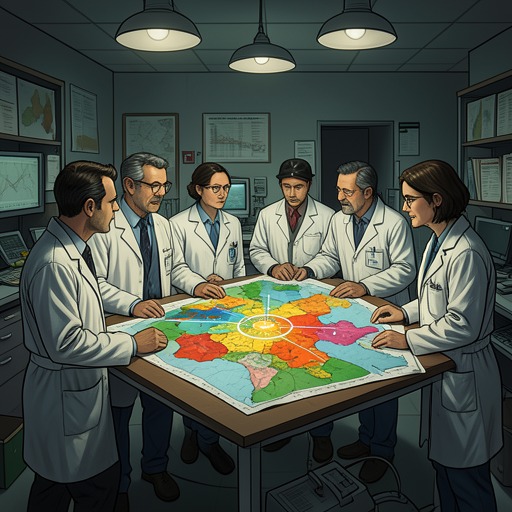
The Wisdom of CrowdsThe Centers for Disease Control and Prevention (CDC) was a participant in the international laboratory network that identified the cause of SARS in 2003. Its researchers independently isolated a coronavirus, and electron microscopist Cynthia Goldsmith was the first to spot it. But the discovery was not the work of one laboratory or one scientist: the case for causation emerged through weeks of shared investigation, comparison, and scrutiny across the network.
Role in the International Investigation
In early 2003, reports of a severe respiratory illness in Guangdong Province and subsequent cases in Hanoi and Hong Kong made clear that the outbreak was not simply influenza. Because the illness spread from person to person, identifying its cause mattered alongside tracking its transmission: knowing the pathogen could enable diagnostic tests and perhaps a vaccine. The World Health Organization contacted eleven research laboratories in countries around the world on March 15 and 16, asking them to investigate together. The CDC joined the effort, which began on March 17 as what the WHO called a “collaborative multicenter research project.”
The collaboration connected laboratories without placing one institution in charge of their scientific work. Researchers held daily teleconferences, shared analyses and test results on a WHO website, and regularly exchanged virus samples. These arrangements let separate teams examine the same material in parallel, compare results, and build on one another’s work rather than waiting for a single laboratory to complete the investigation.
The Coronavirus Finding
The network first considered and rejected multiple possible causes, including viruses found in some patients but not others. By March 21, scientists at Hong Kong University had isolated a promising candidate. That same day, CDC scientists independently isolated a virus that appeared under the electron microscope to be a coronavirus. The identification was unexpected: coronaviruses were known to make animals seriously ill, while their effects in humans generally tended to be mild.
Goldsmith, an electron microscopist at the CDC laboratory in Atlanta, was the person who first spotted the coronavirus. That specific achievement did not, by itself, establish that the virus caused SARS. Over the following week, laboratories in the network detected coronavirus in a wide variety of samples from people diagnosed with the disease, while teams in Germany, the Netherlands, and Hong Kong began sequencing it. In early April, infected monkeys at a laboratory in the Netherlands developed full-blown SARS. By April 16, a month after the collaboration began, the laboratories were confident enough to announce that the coronavirus caused the disease.
A Collective Discovery
The distinction between spotting a candidate and proving its role is central to the account of the CDC’s contribution. Goldsmith identified the virus first, but evidence from laboratories across the network established its connection to SARS. The work that ruled out other candidate viruses also mattered: eliminating possibilities narrowed the field and strengthened the conclusion. The book therefore describes the discovery as collective rather than assigning the explanation of the disease to one person or institution.
The CDC’s result gained scientific standing through this process of circulation and assessment. Research data and images were made available to other laboratories, which could compare findings, test interpretations, and use the shared results in further work. Once the scientific community accepted the evidence that the coronavirus caused SARS, laboratories around the world began pursuing possible tests and vaccines on that basis. The CDC’s independent isolation was an important part of the chain, but the international network made the evidence persuasive and useful beyond any one lab.